

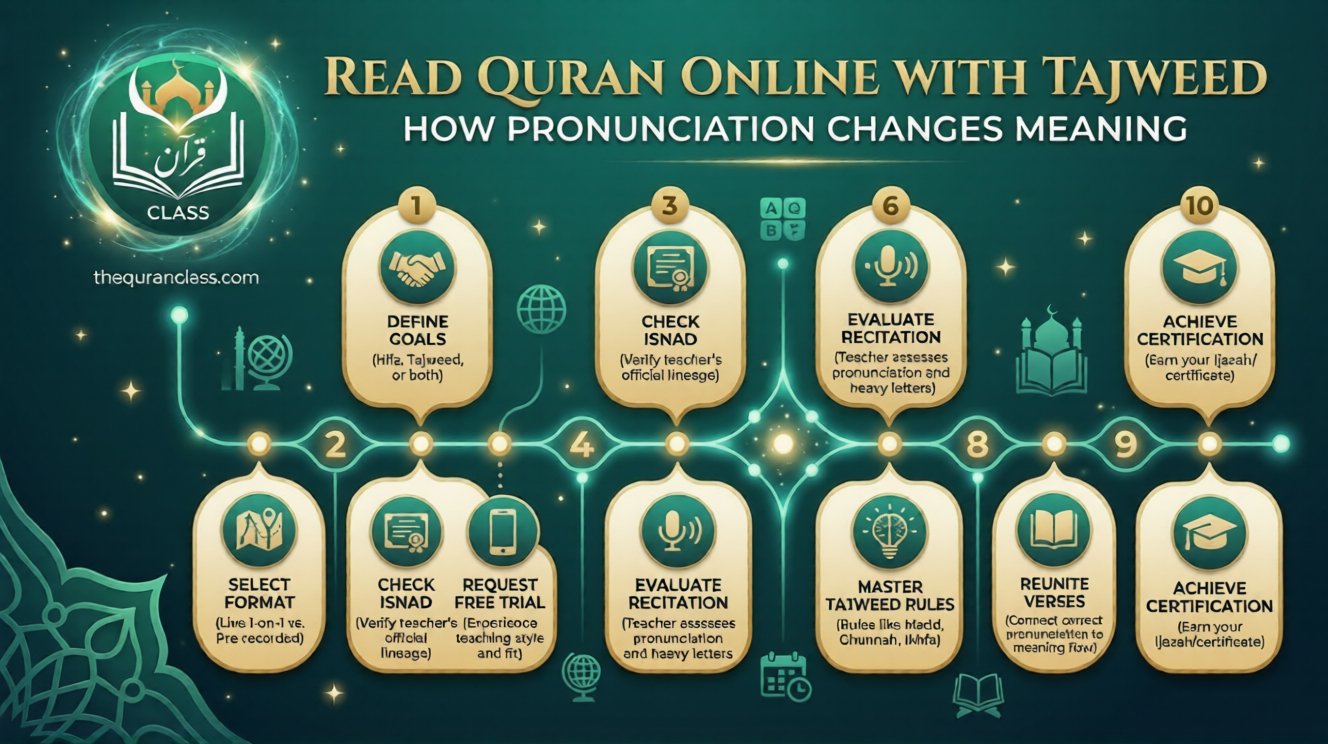
If you want to read Quran online with Tajweed, it is not just a beautiful blessing but also a vital spiritual duty for every Muslim. The Holy Quran is the final word of Allah. We try our best to memorize its beautiful verses. We read them daily in our prayers. However, Arabic is a very sensitive language. A minor change in your voice can change the whole meaning. This is why learning Tajweed is so important.
The word “Tajweed” means to improve or make something beautiful. In Quranic studies, it means giving every single letter its correct right. When we read without rules, we make hidden mistakes. These mistakes can distort the divine message. You must learn the exact exit points of every sound. This protects the original text from any alteration.
In this comprehensive guide, we will discuss the impact of pronunciation. We will look at real examples of how meanings shift. We will also show you how to master this sacred skill comfortably from home.
The Spiritual Reality of Tajweed Quran
Tajweed is not a modern creation. It is not just a style of singing. It is the exact way Angel Jibreel delivered the Quran to the Prophet Muhammad (PBUH). Therefore, reading correctly is an act of obedience. It shows deep respect for the speech of Allah.
Allah commands us in the Quran to read with care. We should not rush through the words. We must say them slowly and clearly. Rushing causes major pronunciation errors. It can make your prayer invalid. That is why scholars emphasize learning rules properly under expert guidance.
Two Main Types of Recitation Mistakes
Scholars divide recitation errors into two categories. Knowing them helps you fix your reading quickly:
1. Major Mistakes (Lahn Jalee)
These are clear and obvious mistakes. Anyone with basic Arabic knowledge can hear them. Examples include changing a vowel sound completely. Replacing one letter with another is also a major mistake. These errors are strictly forbidden. They change the core message of the scripture.
2. Minor Mistakes (Lahn Khafee)
These are hidden and subtle mistakes. They do not always change the words. However, they reduce the beauty of the recitation. Examples include forgetting a nasal sound (Ghunnah). Missing an elongation rule (Madd) is another example. You should always try to avoid them to keep your reading perfect.
To avoid these hidden mistakes, the best solution for modern Muslims is to read Quran online with Tajweed under the supervision of a certified Qari.
Real Examples: How Mistakes Change the Meaning
Let us look at common mistakes. These examples show how a small voice shift alters a whole verse:
Example 1: Qalb (Heart) vs. Kalb (Dog)
The Arabic word for “Heart” is Qalb. It starts with a deep, heavy letter Qaf (ق). If you pronounce it lightly, it sounds like a Kaf (ك). This turns the word into Kalb. In Arabic, Kalb means “Dog.” Changing a heart into a dog changes the meaning of the verse completely.
Example 2: Al-‘Aleem (The All-Knowing) vs. Al-Aleem (The Painful)
Allah is Al-‘Aleem. This means “The All-Knowing,” and it starts with the deep throat letter Ayn (ع). If you make the sound flat, it sounds like a Hamza (أ). This changes the word to Al-Aleem, which means “The Painful” (usually used for punishment). This is a dangerous mistake when describing Allah.
Example 3: Khalaqa (To Create) vs. Halaqa (To Shave)
The verb Khalaqa means “He created” and uses the rough throat sound of the letter Kha (خ). If you soften it into a simple, breathy letter Ha (ح), it becomes Halaqa. In Arabic, Halaqa means “He shaved.” Mixing these two words up completely destroys the context of creation verses.
Linguistic Rules and Technical Outcomes
Every rule in Tajweed serves a strict grammatical purpose. Let us look at how they protect the text:
| Rule Element | Correct Practice | Incorrect Practice Result |
|---|---|---|
| Short Vowels (Harakat) | Keeps grammar stable. | Changes the subject into the object. |
| Heavy Letters (Tafkheem) | Adds depth and majesty. | Flattens sacred words into everyday speech. |
| Extensions (Madd) | Stretches sounds accurately. | Can turn a positive phrase into a negative denial. |
| Nasalization (Ghunnah) | Connects letters smoothly. | Makes recitation sound dry and rushed. |
Consider Surah Al-Fatiha as a clear example. We say “An’amta ‘alayhim”. This means “You have bestowed favor upon them”. The vowel sound confirms Allah did it. If you change it to a Dammah sound, it means “I have bestowed favor”. This is a massive theological mistake.
Why You Should Choose to Read Quran Online with Tajweed
In the past, finding an expert local teacher was difficult. You had to travel long distances. Today, technology makes everything simple. When you choose to read Quran online with Tajweed, it gives you amazing advantages that traditional classrooms cannot offer:
- Access to Native Arab Scholars: You can learn from teachers living in historical Islamic centers. They have flawless pronunciation.
- Private 1-on-1 Sessions: You get the undivided attention of your tutor. They listen to every breath and correct you instantly.
- Full Schedule Control: You can plan your lessons around your routine. Read early in the morning or late at night.
- Comfortable Home Environment: You do not need to commute. This saves valuable time and energy for your family.
Frequently Asked Questions
Can absolute beginners learn Tajweed online easily?
Yes, they can. Online lessons use clear visual slides and interactive tools. Tutors guide you step-by-step from the Arabic alphabet up to complex rules. The process is very smooth.
Will Allah reward me if I struggle with pronunciation?
Yes, absolutely. The Prophet (PBUH) promised a double reward for those who struggle while reading. One reward is for the recitation. The second reward is for your hard work and persistence.
How many months does it take to fix basic reading errors?
Most students see massive improvements within 3 to 6 months. It requires taking consistent classes and practicing a few minutes every day so you can successfully learn to read quran online with tajweed.
Start Your Journey Today
Pronunciation has a massive impact on the meaning of the Holy Quran. A minor slip of the tongue can alter the divine message. Learning correct rules is a sacred duty. When you decide to read Quran online with Tajweed, it protects your daily prayers and brings endless blessings into your household.
If you are ready to fix your errors, your search ends right here. We are here to help you succeed.
At The Quran Class, we offer premium interactive programs. Our male and female tutors are certified scholars. They hold authentic chains of narration. We provide flexible timings, personalized tracking, and 1-on-1 attention tailored to your exact speed.
Don’t let errors change the word of Allah. Register for a Free Trial Session at The Quran Class today and learn to read Quran online with tajweed perfectly!