
When you decide to read or study the uthmani script quran, you are looking at a preserved writing style that has a rich historical background.
For beginners and students around the world, opening a new copy of the Holy Quran can be a little surprising. They notice that the symbols, vowel marks, and script style look different from the copy they used when they were kids. This is not a change in the Quran itself. Every single word, letter, and verse of the Quran is the same in every single print. The difference is in the script and the formatting systems used to help non-Arab speakers recite accurately.
Modern publishing features two main writing systems used today: the Indo-Pak script and the uthmani script quran system. For Muslims living in countries like the USA…It helps you choose the print that aligns with your educational background, native language habits, and Tajweed learning goals.
In this guide, we will break down the differences between these two scripts. We will talk about the background of Quranic calligraphy. During the lifetime of the Prophet Muhammad, the Quran was written down on things like parchment, bones, and palm leaves. When Uthman bin Affan was the caliph, the Muslim empire grew fast. Many non-Arab nations became Muslim. To make sure everyone pronounced the Quran correctly, Caliph Uthman ordered official copies to be written using a system.
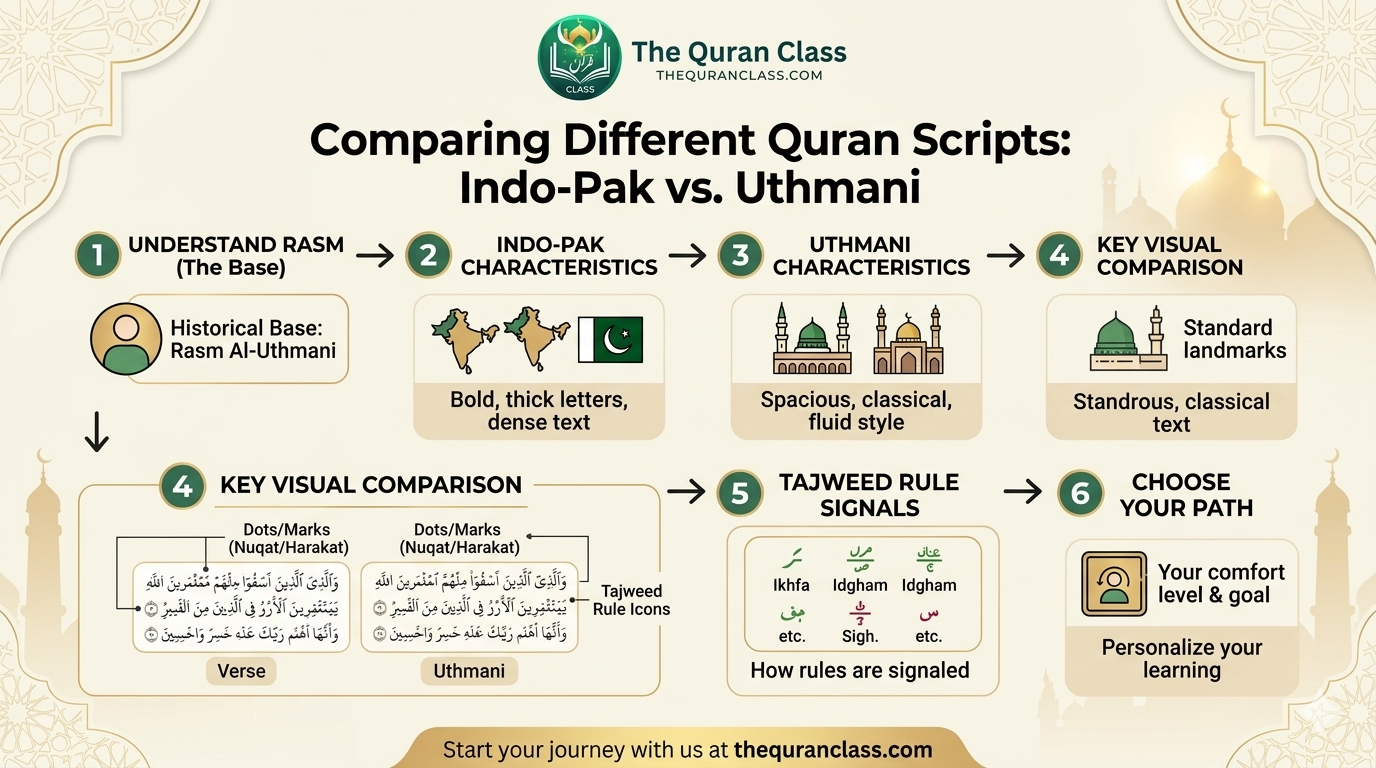
This system is called the Rasm al-Uthmani. It is the base for all Quran prints today. Over time, calligraphers in regions added their own visual aids. They added dots and vowel marks to help non-Arabs read the Quran without making mistakes. This is how the Indo-Pak and modern Arabic styles were created.
What is the Uthmani Script?
The uthmani script quran format is widely recognized as the standard print in Arab countries, North Africa, and most Western Islamic centers It is used in the Medinah Mushaf, which is printed by the King Fahd Complex in Saudi Arabia. The Uthmani script is elegant, spacious, and classical. It follows the grammatical spelling conventions used by the early companions of the Prophet. The vowel marks and stopping signs are very detailed but written with lines.
What is the Indo-Pak Script?
The Indo-Pak script is popular in Pakistan, India, Bangladesh, Afghanistan, and parts of East Asia. It was developed by scholars to help non-Arab populations who were not familiar with Arabic speech patterns. The Indo-Pak script has thick letters. The vowel symbols are placed above or below the letters in a very prominent way. It also has visual aids and stopping rules that make it easy for students to pronounce difficult words without knowing advanced Arabic grammar.
Key Visual Differences Between Both Scripts
There are some visual differences between the two scripts. Let us look at them:
1. Jazam Symbols
In the Indo-Pak script, a silent letter is marked with a symbol called a Jazam. In the Uthmani script, a silent letter often carries a symbol that looks like the head of the letter ‘Khaa’ or it may have no symbol at all.
2. Tanween Formatting
The Indo-Pak script prints vowels perfectly aligned on top of each other. Conversely, the uthmani script quran uses a spacing system. If the double lines are perfectly aligned. If the lines are slightly staggered, it signals to the reader that they must apply a hidden nasal sound or blending rule.
3. Standing Vowel Marks
The Indo-Pak script uses vowel lines to show where a sound needs to be stretched. The Uthmani script uses a version of the actual long vowel letters tucked into the script line to show elongation points.
Comparison Table: Indo-Pak Script vs. Uthmani Script
Here is a comparison table to help you understand the differences at a glance:
| Feature | Indo-Pak Script | Uthmani Script |
|---|---|---|
| Primary Region | Pakistan, India, Bangladesh, South-East Asia. | Arab World, Middle East, Western Countries. |
| Calligraphy Style | Bold, closely packed characters. | Spacious, fluid, and classical Arabic script. |
| Tajweed Color Coding | Often relies on text notes or bold letters. | Strictly integrated into the shapes and colors. |
| Page Structure | Commonly formatted as 15 or 16 lines per page. | Standardized globally as 15 lines per page. |
| Ease for Non-Arabs | Very easy for Urdu, Persian, and Bengali speakers. | Highly logical for students learning Arabic. |
As you can see, both scripts serve the purpose. They use visual approaches to guide the tongue of the reciter correctly.
Which Script Should You Choose for Recitation?
It depends on your history, comfort level, and current learning environment. There is no choice in terms of spirituality, as both represent the exact same words of Allah, though many students prefer the layout of the uthmani script quran for learning.
If you grew up in an Asian household or are learning from a teacher who uses the Indo-Pak method, it is practical to continue with that script. On the other hand, if you are learning Tajweed online or plan to memorize the Quran using digital applications, mastering the uthmani script quran will give you a global advantage.
Frequently Asked Questions
Before deciding whether to switch or stick to your current style, here are some common questions about using the uthmani script quran in daily life:
- Does the meaning of the Quran change between these two scripts?
No, the meaning does not change at all. Every letter, word, sentence, and chapter is perfectly identical. The variations are completely limited to the fonts, the shapes of vowel markings, and the calligraphic styles. - Can a beginner switch from the Indo-Pak script to the Uthmani script easily?
Yes, a student can switch with an amount of practice. It usually takes one to two weeks of consistent reading to get used to the new visual symbols. - Why do modern online Quran academies prefer teaching with the Uthmani script?
Most digital international apps default to the Uthmani script because it matches standard modern Arabic font libraries. It is also the script used in the holy mosques of Makkah and Medinah.
Master Your Chosen Script from Home
Understanding the differences between the Indo-Pak style and the Uthmani script Quran empowers you to read with absolute clarity, confidence, and peace of mind. Both scripts are paths leading to the exact same divine destination.
If you are looking for an academy to perfect your pronunciation, Tajweed, or recitation fluency, we are ready to assist you.
At The Quran Class, we provide personalized 1-on-1 classes designed carefully for Western families and busy individuals. We fully support both the Indo-Pak and Uthmani scripts. Our certified native scholars will adapt completely to whichever script you feel most comfortable with, ensuring your learning process is smooth, accurate, and highly rewarding.
Take the next step in your spiritual journey today. Book Your Free Trial Lesson at The Quran Class. Master your Quranic recitation with elite teachers!
Whichever script you choose, you can start today and read the Quran online
To perfect your recitation in your chosen script, take the next step with a certified Ijazah course