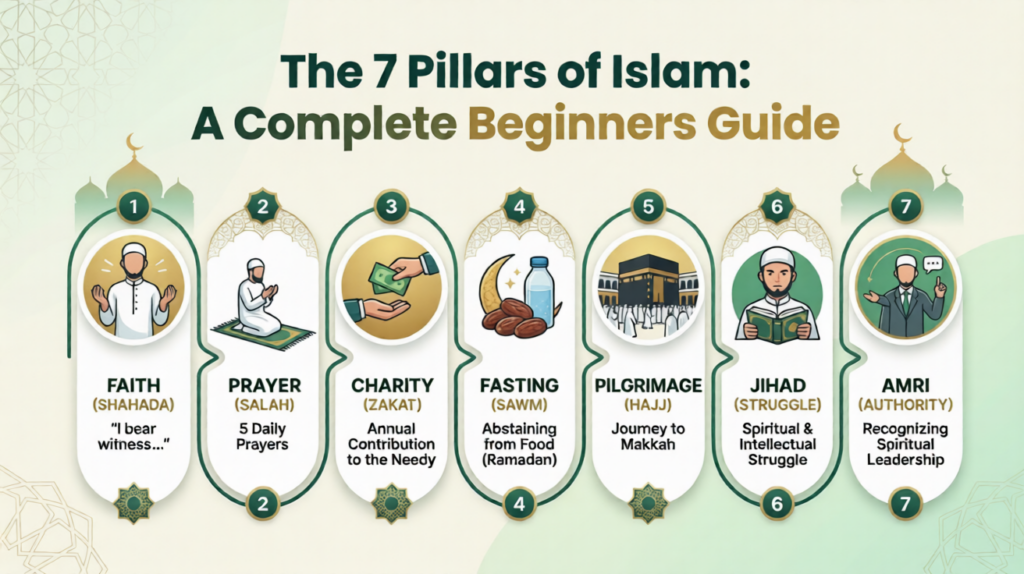
When you start learning about the basics of Islam, it is very helpful to understand the historical context of the 7 pillars of islam versus the universally recognized 5 pillars of Islam.
This helps people who are new to the faith see how deep these teachings are. For people who are new to the faith or studying different religions, these basic practices are a big part of a Muslim’s daily life. They are more than rituals. In fact, the 5 pillars of Islam help a Muslim’s relationship with God, their community, and themselves.
When comparing the theological aspects of the 7 pillars of islam versus the foundational 5 pillars, it becomes clear that Islam is a mix of what you believe in your heart and what you do in your daily life. You cannot really experience the beauty of this faith. Also, doing rituals without knowing what they mean does not have any value. The 5 pillars of Islam bring these two things together perfectly. They give you a monthly and yearly routine that helps keep your faith alive and active.
In this beginner’s guide, we will explain each of the 5 pillars of Islam in simple terms. We will talk about why these practices exist, how people do them, and how they help society. By the end of this article, you will have an understanding of the core of Islam.
The Spiritual Core: What Does a “Pillar” Mean in Islam?
To understand this idea, imagine a building. A building cannot stand without its supporting columns. If you remove one column, the whole structure becomes weak. The 5 pillars of Islam support a Muslim’s life in the same way.
These basic practices are required for every adult Muslim who is able to do them. Following the 5 pillars of Islam helps people stay on the path and avoid bad habits. On a mental level, they help reduce anxiety. Globally, they create a sense of equality among millions of believers from different cultures, regardless of whether they study the core 5 pillars or the historical 7 pillars of islam branches.
The 5 Core Pillars of Islam Explained
Let us look at the five pillars that shape the life, character, and identity of a practicing Muslim:
1. Shahada (The Declaration of Faith)
The Shahada is the first step to becoming a Muslim. It is a simple yet profound statement: “There is no god except Allah, and Muhammad is His messenger.” By saying these words with sincerity, a person becomes a Muslim. The Shahada means a believer promises to worship one God and reject all forms of idolatry.
2. Salah (The Five Daily Prayers)
Salah is a direct connection between a Muslim and Allah. Muslims pray five times a day: at dawn, afternoon, late afternoon, sunset, and night. Before praying, they perform a physical purification ritual with water. During the prayer, they face the holy city of Makkah and recite verses from the Quran. The 5 pillars of Islam, especially Salah, help people remember God throughout their busy day.
3. Zakat (Charity)
Islam emphasizes helping the poor. Zakat is an annual charity for every Muslim who has a certain amount of extra wealth. They give a small portion of their savings to those in need. In Islam, Zakat is not seen as a voluntary gift; it is a fundamental right of the poor. The 5 pillars of Islam, including Zakat, help purify a Muslim’s wealth and make sure money is distributed fairly in society.
4. Sawm (Fasting in Ramadan)
During Ramadan, healthy adult Muslims fast from dawn until sunset. They abstain from food, drinks, and bad behaviors during the day. Fasting helps people develop self-control, patience, and empathy. It reminds them of the struggles faced by the poor and creates a beautiful space for spiritual reflection.
5. Hajj (The Pilgrimage to Makkah)
Hajj is a sacred journey to Makkah that every Muslim must take at least once in their lifetime if they are physically and financially able. Millions of Muslims gather to perform these rituals together every year. Hajj shows absolute equality and breaks down barriers of race, status, and nationality.
Understanding Terms: 5 Pillars vs. 7 Pillars
Different terms can sometimes confuse beginners, especially when reading about the 7 pillars of islam found in certain historical jurisprudence. The 5 pillars of Islam are the core practices that all mainstream Muslims agree on. Some historical branches of law include other important concepts, making a list of the 7 pillars of islam within specific traditions. However, the ultimate goal remains exactly the same: to submit to Allah and live a righteous life.
The Social and Moral Impact of the Pillars
When a society practices the 5 pillars of Islam, the community is positively transformed. Salah brings people together, building local unity. Zakat helps ensure no single family goes hungry. Ramadan teaches patience and shared empathy, while Hajj destroys racism by bringing people together as absolute equals before God.
Frequently Asked Questions
If you have questions about foundational practices or how specific traditions view the 7 pillars of islam, here are some answers to common queries:
- Can a person skip fasting if they are traveling or sick?
Yes, they can. Islam is a religion of ease and mercy. If a person is traveling, pregnant, or ill, they do not have to fast during Ramadan. They can easily make up for the missed days later. - Are children required to pay Zakat or perform Hajj?
No, they are not. Financial obligations like Zakat and demanding journeys like Hajj are only required for adults who possess independent wealth and physical ability. - Why is praying in Arabic mandatory for all Muslims?
Arabic creates a beautiful sense of belonging among Muslims globally. Whether you are in America, Asia, or Africa, the prayer sounds exactly the same. Reciting in Arabic also protects the Quran from translation errors and preserves its true meaning.
Build Your Spiritual Foundation
Learning about the 5 pillars of Islam shows that Islam helps you build a highly balanced life. By mastering these basics, you set yourself up for a lifetime of spiritual growth and internal peace.
If you are ready to learn about the 5 pillars of Islam and understand its core values, we are here to help you.
At The Quran Class, we provide personalized online education designed for busy families and professionals. Our certified scholars will teach you proper Quran recitation, daily prayers, and Islamic history in a highly flexible format.
The 5 pillars of Islam are the foundation of a Muslim’s life, helping them grow spiritually as part of their daily life.
Take the first step towards understanding Islam today. Register for your Free Trial Lesson at The Quran Class. Start your journey with absolute confidence!